
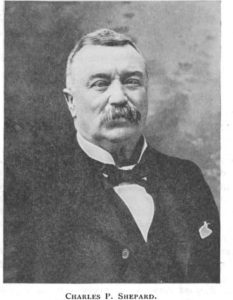
Charles Pearson Shepard: A Boscawen Sharpshooter in the Civil War
Among the thousands of New Hampshire men who answered the call to arms in 1861 was Charles Pearson Shepard of Boscawen, a small town along the Merrimack River. Shepard's path into the Civil War led him into one of the conflict's most demanding and specialized branches of service: the United States Sharpshooters, the elite marksman corps organized by Hiram Berdan.
Shepard enlisted on August 30, 1861, joining Company E. Sharpshooter service was not open to just any volunteer. Candidates had to demonstrate exceptional marksmanship before being accepted into the ranks, typically by placing a string of shots inside a ten-inch circle at two hundred yards while shooting from a rest, and repeating the feat at one hundred yards firing offhand. This standard weeded out all but the most accomplished shooters, and it reflected Berdan's vision of a force that could deliver precise, long-range fire rather than the massed volleys typical of Civil War infantry combat.
New Hampshire's sharpshooters, including Shepard, were promised the latest in rifle technology: breech-loading Sharps rifles, prized for their accuracy and rate of fire compared to standard muzzle-loading muskets. The state's commitment to equipping these men was serious enough that when Governor Ichabod Goodwin discovered his troops had not yet received the promised weapons, he threatened to withdraw them from the war effort entirely rather than send them into combat under-equipped. Governor Goodwin had already gone so far as to borrow against his own name in May 1861 to help arm the state's regiments, an act later ratified by the New Hampshire Legislature.
Shepard's active service was brief but brutal. He was sent almost immediately to the front near Richmond, Virginia, where Union and Confederate forces clashed in the Peninsula Campaign. His service in the field came to an end on July 1, 1862, the final day of the Seven Days Battles, at Malvern Hill. There, in one of the war's fiercest artillery duels, Shepard was shot through the abdomen, a wound serious enough to end his time on the battlefield.
Shepard survived his wound and returned home to Boscawen, living for six more decades. Long after the war, he suffered another brush with serious injury when he was gored in the leg by a bull, an accident that left him unable to use the leg for more than a year. He recovered from this as well, living to the age of eighty. Charles Pearson Shepard died on May 1, 1922, and was laid to rest in Boscawen's Plains Cemetery, alongside fellow sharpshooter, James W. Bent.
Shepard's story is a modest but telling window into the war's texture at the local level. Behind the famous campaigns and generals were ordinary townsmen like Shepard, who trained to a demanding standard, marched into some of the war's bloodiest fighting, carried the physical toll of that service for the rest of their lives, and returned to quietly live out their years in the communities that had sent them off to fight.
